
For a package from a major lead-generation platform promising 230 enquiries a year.
Rudi Electrics case study · North London
From almost invisible.
To 189,155 impressions.
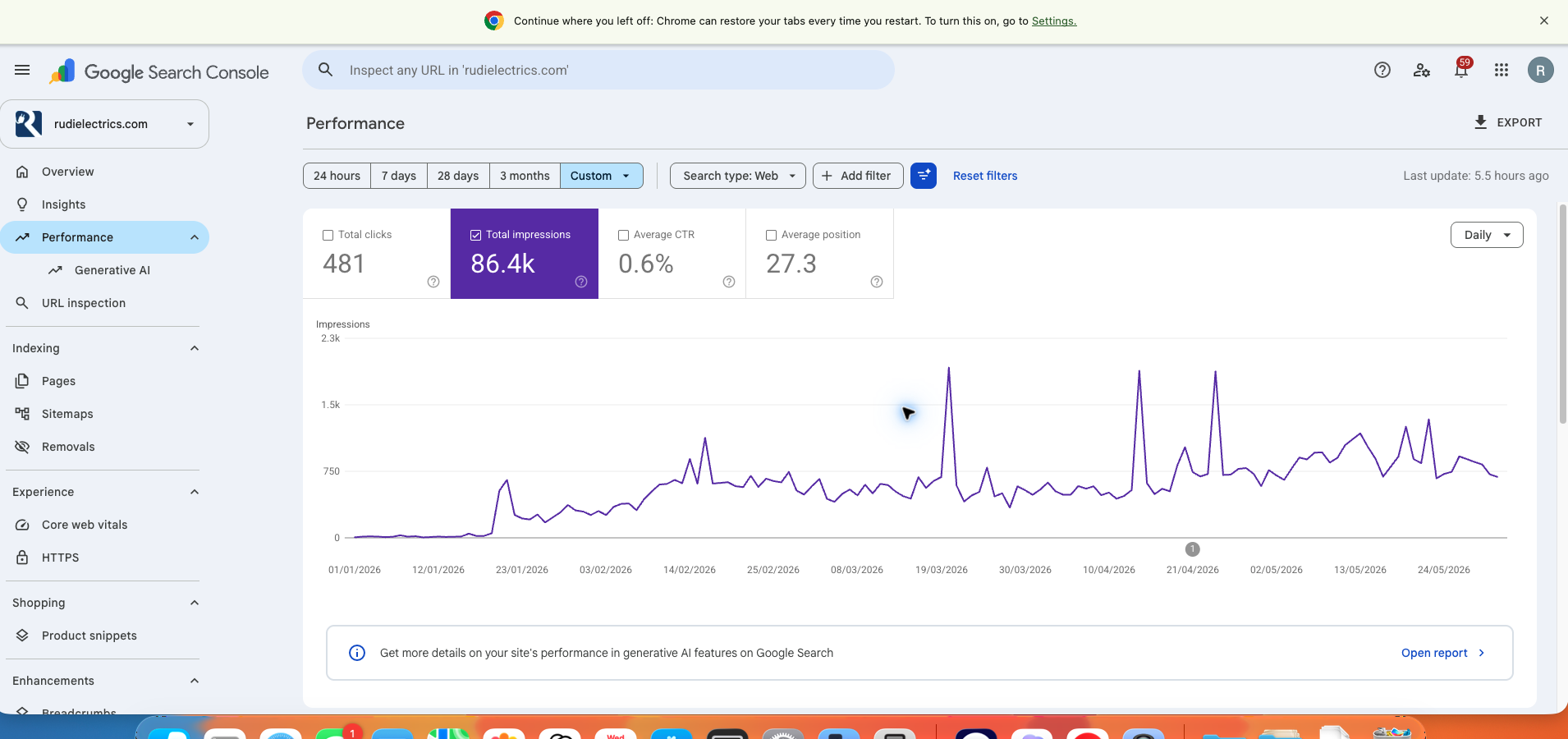
When we started, Rudi Electrics was averaging about 16 Google impressions a day. We rebuilt the website around real services, real customer questions and genuine North London expertise. In the immediately following period, daily visibility multiplied 18.8×.
Google Search Console · Web search · 1 January–17 August 2026 · Checked 19 August 2026
Average daily impressions
161–18 January
→1,7361–17 August
about 110× the opening baselineNearly invisible on Google. Then 18.8× the daily visibility in the immediately following period—and 189,155 impressions by August.
From rented promises to owned demand
The enquiries are direct.
The source belongs to Rudi.
Reported consistently by Rudi Electrics from organic search, with no paid advertising running and no fee charged for each lead.
Source note: Search Console verifies the impression figures. The historic supplier price and package promise, and the current 2–5 daily website-enquiry range, are Rudi Electrics business figures. The cumulative search period recorded an average position of 25.2 across all reported queries; this is a broad portfolio average, not a claim that every keyword ranks on page one.
Compare owned website demand with lead-generation platforms →The moment visibility changed
Nearly invisible.
Then the graph changed.
Rudi Electrics went from 15.8 impressions a day to 296.1 in the immediately following period. The breakthrough happened within days, then Google visibility continued at a materially higher level for months.
What “almost overnight” means
The change,
in hard numbers.
The periods are different lengths, so the honest comparison is the daily average. That still shows a dramatic shift: 18.8 times the opening visibility.
18.8×more daily visibility in the immediately following period
The starting point
A good electrician.
A weak digital asset.
Rudi Electrics had the practical experience, qualifications and range of work customers needed, but the website was not expressing that depth. A limited site could introduce the business; it could not properly answer the many service, location and trust questions behind local electrical searches.
That left too much dependence on rented enquiry sources. The goal was not to manufacture traffic. It was to build an owned website that could earn visibility under the Rudi Electrics name, help customers make an informed choice and turn genuine demand into direct enquiries.
See the controlled website-redesign approach →Website first.Build the owned source of visibility and enquiries.System second.Organise the work those enquiries create.
The website behind the result
From another name online.
To the obvious local choice.
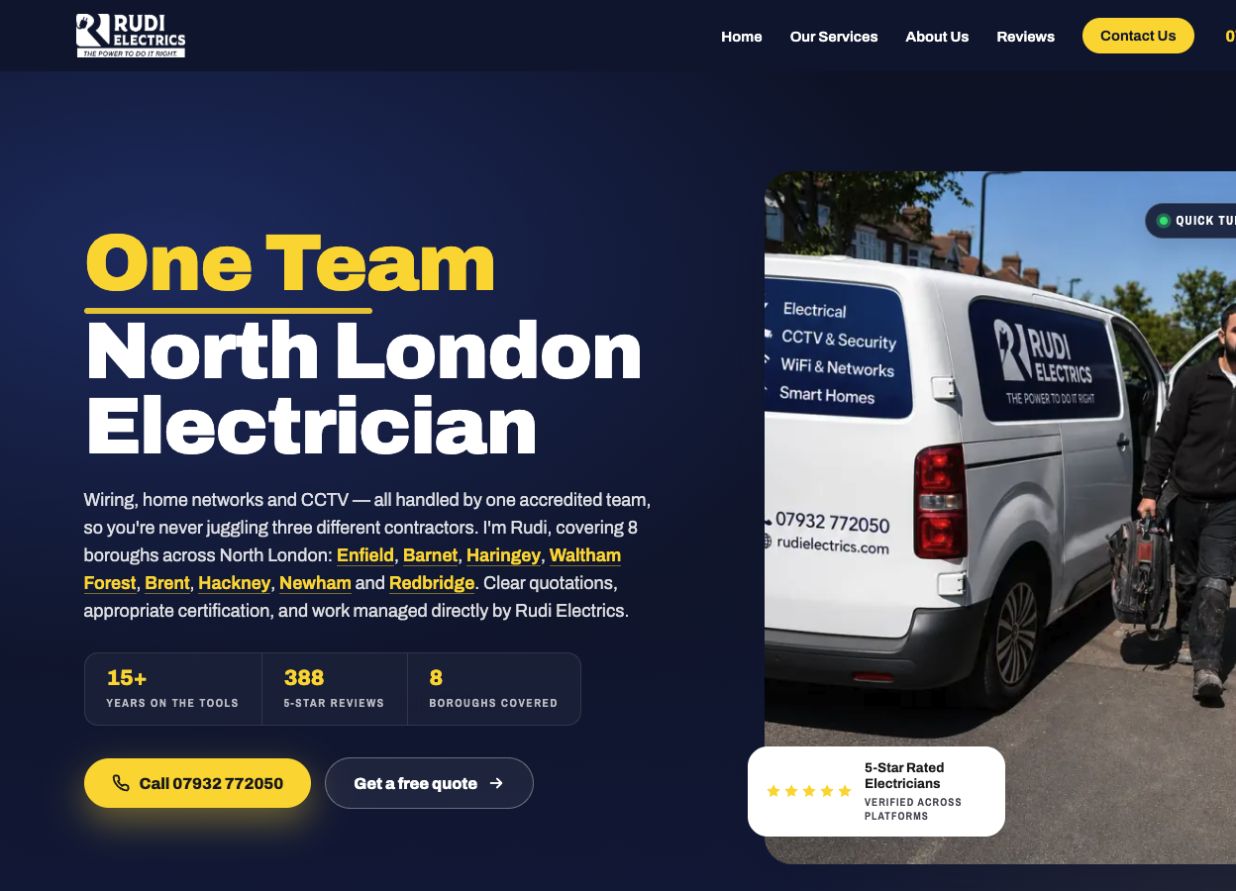
Google visibility gets the customer through the door. The website then has to win confidence. Rudi Electrics now looks as established online as the business is in the real world: clear offer, real tradesman, real proof and an immediate route to enquire.
Built for the phone in their hand
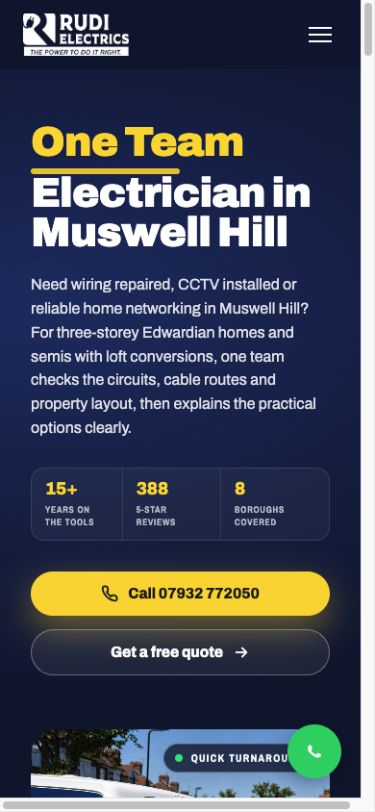
Not a desktop website squeezed onto mobile.
Someone searching for an electrician is often comparing businesses quickly. The mobile experience confirms the area, demonstrates relevant knowledge and keeps Call and Get a free quote within an easy decision path.
Specific enough for Google.Clear enough for a homeowner.
Easy enough to act on.
Design with a job to do
Every visual choice
reduces uncertainty.
A trade website is not decoration around a phone number. It has to help someone understand the service, trust the person behind it and know what to do next.
Answer the first questions first
Service, location, who will do the work, experience and next steps appear in a deliberate order. Strong headings and grouped proof make the page understandable before every paragraph is read.
Show the real business
Rudi, the van, qualifications, reviews and genuine service detail replace anonymous stock imagery and empty claims. The visual identity feels established without hiding the tradesman customers will meet.
Depth without a wall of text
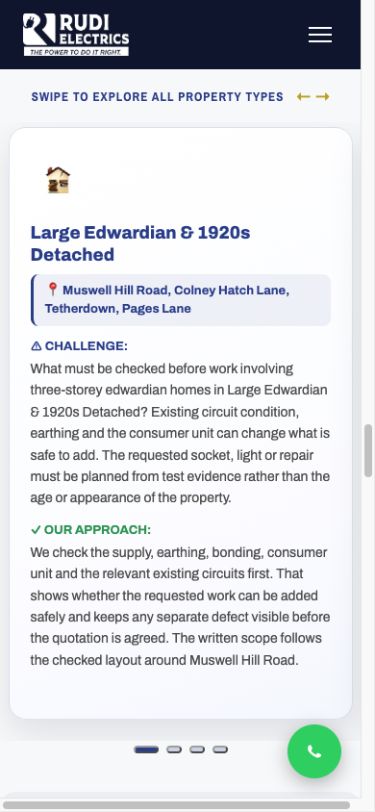
Long-form information is divided into short sections, cards and swipeable property groups. Visitors can explore one idea at a time while the full content remains present for search engines and assistive technology.
Useful without special gestures
Swipeable areas use native horizontal scrolling and scroll snap rather than automatic movement. Content remains in normal reading order, keyboard controls still work, text is not baked into images and buttons retain generous touch targets.
What changed
Not one trick.
A proper foundation.
- 01
From one page to a service architecture
Core electrical services gained clear, substantial destinations instead of competing for a few paragraphs on one page. Electrician, EICR, consumer-unit, rewiring, CCTV, smart-home and network work could be understood in their own context.
- 02
Real local relevance
Service-area pages were built around genuine North London coverage, housing stock, customer concerns and property context. They were not produced by swapping one town name for another.
- 03
Detailed answers preserved
Customer questions, trade-offs, technical explanations and service limitations stayed visible. The current build validates the original detailed FAQ source across 286 rendered pages, with matching visible content and structured data.
- 04
Technical search foundations
Each important page received descriptive metadata, canonical URLs, internal links, breadcrumbs, relevant schema, crawlable HTML and sitemap coverage, supported by automated checks rather than occasional manual fixes.
- 05
Mobile trust and direct conversion
The website explains the work before the call, presents authentic proof and gives customers direct contact routes. Enquiries belong to Rudi Electrics rather than entering through somebody else’s marketplace.
SEO and CRO working together
From a Google search
to a direct enquiry.
SEO earns the right visit. Conversion design helps that visitor make a confident decision. The two systems were planned as one connected journey rather than separate marketing tasks.
- 01Specific search
A customer searches for a real service in a real North London area.
- 02Relevant page
The title, heading and opening copy immediately confirm the service and location.
- 03Proof and answers
Experience, reviews, process, property detail and FAQs remove reasons to hesitate.
- 04Timed CTA
Call and quote actions appear at natural decision points—not only at the top or bottom.
- 05Owned enquiry
A clear, accessible form sends the lead directly into Rudi Electrics’ own workflow.
Strategic content and placement
More pages were not
the strategy by themselves.
Each page needed a clear search purpose and a clear business purpose. Content earns attention; layout, proof and calls to action help convert that attention into a useful next step.
SEO foundations
- One clear intent per destination: important services and service-area combinations receive focused pages.
- Useful local substance: housing stock, streets, customer worries and installation context make pages genuinely different.
- Question-led depth: detailed FAQs cover costs, process, trade-offs and technical concerns people search before calling.
- Connected architecture: internal links, breadcrumbs, metadata, canonical URLs, schema and sitemaps help people and crawlers understand the site.
- Measured improvement: Search Console shows which queries earn visibility and where titles, relevance and click-through still need work.
CRO foundations
- Hero actions: call and quote routes are visible as soon as the visitor confirms they are in the right place.
- Proof beside claims: real imagery, experience and review evidence appear close to the promises they support.
- Contextual prompts: CTAs return after service explanations and trust sections, when another decision is likely.
- Low-friction forms: labels, validation, large controls and a logical field order make completion easier on mobile.
- No dead-end content: detailed location and FAQ sections lead naturally back to a call, quote or related service.
Accessibility is conversion work
More people can use it.
More people can enquire.
Readable structure
Semantic headings, short paragraphs and descriptive link text create a reliable reading order for visual visitors and screen-reader users.
Keyboard and touch
Interactive elements remain reachable without a mouse, while large controls and spacing support one-handed mobile use.
Contrast and focus
High-contrast text, visible focus states and controls that do not rely on colour alone make actions easier to identify.
Motion with restraint
Information does not depend on auto-rotating slides. Native scrolling, scroll snap and reduced-motion support keep the experience under the visitor’s control.
Beyond the brand name
Visibility for work
customers need.
Brand searches matter, but the commercial test is whether the website appears for services and places before the customer already knows the company name.
cctv installation north london1,650 impressions
emergency electrician north london1,105 impressions
electrician muswell hill894 impressions
Selected Search Console query totals for 1 January–17 August 2026. They demonstrate discovery beyond the business name; they do not represent enquiries or completed jobs.
WHAT THE
DATA PROVES
DATA PROVES
A case study without theatre
Visibility is real.
So are the limits.
It proves
Google began showing Rudi Electrics far more often, across relevant non-brand searches, and the increase persisted for months.
It does not prove
That every impression became a visit, every visit became an enquiry or every enquiry became revenue. Search Console does not make those claims.
The work continues
Click-through rate, rankings, conversion and page quality still need improvement. Organic search is a business asset to maintain, not a finished campaign.
Why this became TradeStead
Build the source.
Then run the work.
Rudi Electrics proved the first part: a substantial owned website can create meaningful organic visibility for a real trade business. When direct enquiries grew, the next problem was operational—keeping customers, quotes, bookings, photographs, invoices and review follow-up connected. That is the foundation TradeStead now builds for other UK trades.